
The best party in Tales of Eternia Remastered is Reid, Farah, Keele and Meredy, with the Craymel Cage split deciding who heals and who carries the damage.
Tales of Eternia Best Party Setup and Team Builds
The best party in Tales of Eternia Remastered is Reid Hershel, Farah Oersted, Keele Zeibel and Meredy: two front-liners and two Craymal Mages. That four holds all four combination artes, keeps both Craymel Cages on the field so healing and damage can sit in different cages, and pairs the widest weapon list in the game with the fastest melee chain. It is also the party the story hands you in Inferia, so the recommendation costs you nothing. Chat and Max are swaps, not upgrades.
- Four characters fight, six are playable, and every battle screen in Eternia is built on four slots.
- Keele and Meredy hold one Craymel Cage each. A spell exists only while the two Craymels that generate it sit in different cages, so the cage split sets your spell table. Levels do not.
- In the original release Keele and Meredy could not combo, Chat could not combo, and Max could only combo with the Canceler equipped.
- This release is single-player only, so every build here assumes three AI allies rather than three friends on controllers.
What Each of the Six Characters Brings to a Slot
Weapon and armour classes are locked to characters, so a slot is also a gear decision. The roles below are original-release data: the remaster's feature list describes no change to character roles or combo rules, and no remaster source publishes a role table of its own.
| Character | Weapons | How they unlock skills | What the slot buys |
|---|---|---|---|
| Reid Hershel | Swords, spears, axes, halberds, daggers, L-swords | Levelling his Slash and Thrust counters | The widest weapon list in the game, and the character most players control |
| Farah Oersted | Knuckles | Levelling her Punch and Kick counters | The fastest melee chain, and she anchors two combination artes with either mage |
| Keele Zeibel | Rods and maces | Craymel levels, no skill list | Starts with Aqua Edge, Wind Blade and Fireball in the original spell table; his casting can be sped up by hand |
| Meredy | Whistles | Craymel levels, no skill list | Starts with Grave, Ice Needles and Lightning; the only character who can cast Destiny |
| Chat | Bags | Seeing specific events, not levelling | Event-gated toolkit, and no combo chain in the original system |
| Max | Guns | Seeing specific events, not levelling | The only gun user, so he never competes with Reid for sword drops |
Two naming traps before you plan anything. Max is called Fog in the Japanese version, so older material describing Fog means Max. And the 2006-era RPGClassics shrine that most of this page's Craymel data traces back to spells him "Kelle" in its rules text while writing Keele in its own tables. Same character.
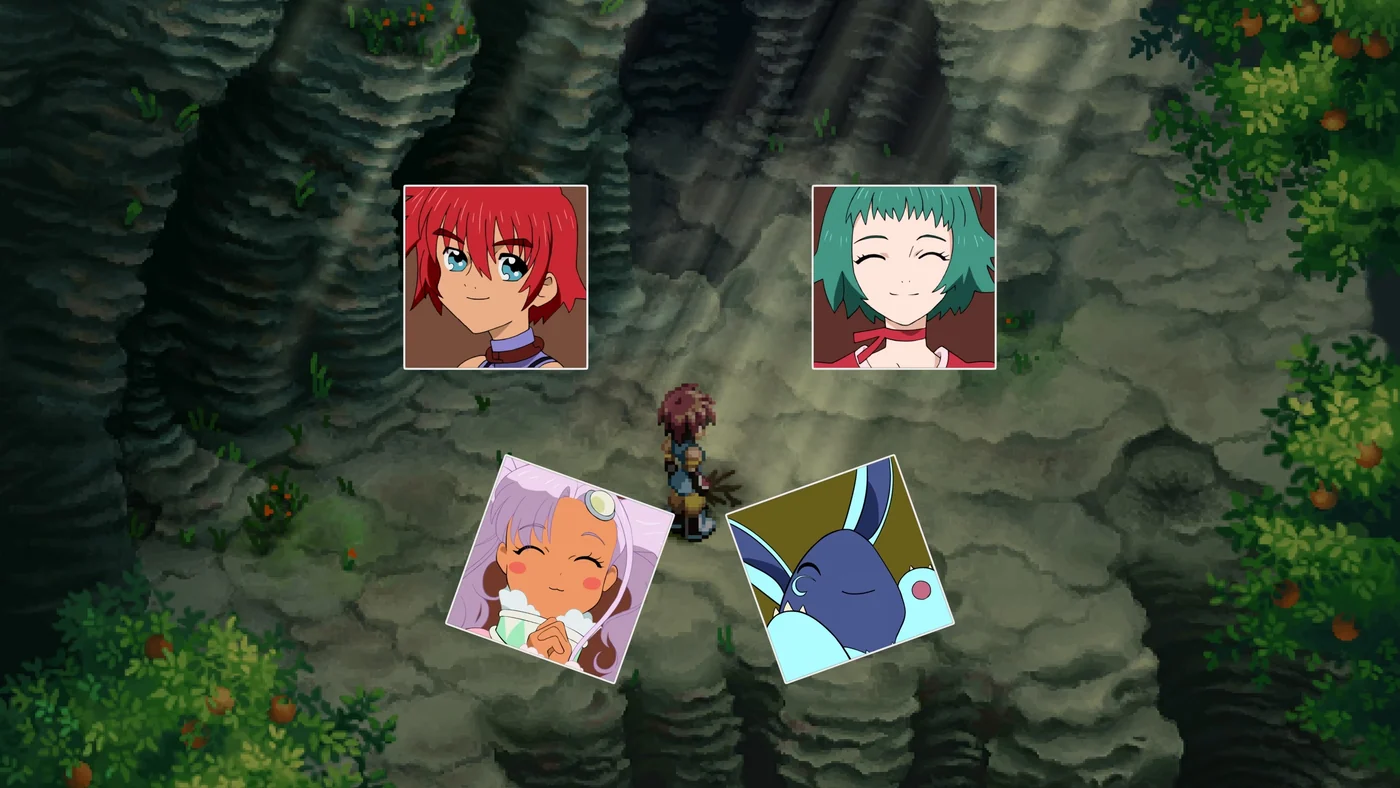
Build A: Reid, Farah, Keele and Meredy
The default answer, and not for nostalgia. The original combination-artes list pairs front-liners with mages and names who may take part in each.
| Combination arte | Who must be in the line | Artes used | Effect |
|---|---|---|---|
| Flaming Sword | Reid and Keele | Demon Hammer plus Fireball | Fire-element Demon Hammer-style attack |
| Serpent Knuckle | Farah plus Keele or Meredy | Rising Dragon Strike plus Heal | Poisonous strikes with Farah |
| Lightning Strike | Farah plus Keele or Meredy | Twin Palm Strike plus Lightning Blade | Lightning-element attack |
| Earth Divide | Reid plus Keele or Meredy | Spiral Attack plus Cyclone | Wind-element spinning sword attack |
Read the first row carefully: Flaming Sword names Keele specifically, so a Meredy-only line loses it, while the other three accept either mage. Fielding both mages is the only way to hold all four at once.
The Craymel Split Is Your Damage and Healing Ceiling
A Greater Craymel sits in one of two cages, one per mage. Spells are not owned by characters; they are generated by pairing two Craymels held in different cages, linked once with the Fringe command and usable only while those two stay apart. No arrangement of ten Greater Craymels across two cages unlocks everything, so a party choice is also a spell-table choice.
Healing then has exactly one owner. Every heal in the original table runs through Undine, so the Undine holder is your healer whether you planned it or not.
| Spell | Craymels and levels required | Effect | TP |
|---|---|---|---|
| Heal | Undine lvl 1, Sylph lvl 1 | Restores ally HP | 16 |
| Nurse | Undine lvl 14, Celsius lvl 1 | Restores greater ally HP | 42 |
| Cure | Undine lvl 22, Maxwell lvl 1 | Restores roughly 90% of all HP | 32 |
| Restore | Undine lvl 25, Rem lvl 1 | Restores HP within an area around the caster | 60 |
| Resurrection | Undine lvl 25, Sekundes lvl 1 | Restores life of allies | 96 |
| Undine summon | Undine at Max Vitality | Water damage to all enemies, restores ally HP | 20 |
| Rem summon | Rem at Max Vitality | Restores all ally HP | 60 |
| Destiny | Meredy only, and it needs the item the old tables abbreviate as S.D. | Massive damage to all enemies, once every 30 minutes of play | 133 |
Every number and level requirement above is from the original release spell table, not a remaster-measured value, and the remaster has published no Craymel table of its own. Treat the thresholds as the original bar to clear.
One mechanical tiebreaker decides who gets Undine: in the original, Keele speeds up his own casting by pressing the direction prompts that appear next to his HP and TP readout, and Max can do the same for his skills. The healer is whoever you most need to land a cast before the enemy's next swing, so Keele on Undine is the pick, with Meredy carrying the offensive lines: Volt for the Lightning-to-Thunder-Blade ladder, Celsius for Ice, Gnome for Earth, Shadow for the Dark Force line. Running a single mage instead means choosing between Restore-quality healing and a wide offensive table.
Vitality runs from 1 to 10 in the original system. Casting a spell of the same element as a Craymel at Max Vitality drops it straight to 5, no two Craymels can hold Max Vitality at once, and a second one reaching the top pushes the first to 9. Casting the opposing element drains it too. A mage left on full auto can therefore burn your summon window before you use it, which is why the original habit of highlighting a character on the skills screen and toggling individual spells off with the Square button still matters here.
Build B: Physical-Heavy, Reid, Farah, Max and One Mage
The alternative worth testing, especially on the harder combat levels, drops a mage for Max and leans on bodies. Reid and Farah keep their combo chains, Max adds a third front-line presence with the only gun in the weapon list, and the remaining mage still heals. Max's gun class also draws on a gear pool nobody else uses.
The costs are real. One cage instead of two halves your spell table and means Undine can no longer move between mages. You inherit Max's original limitations too: his skills come from events rather than levels, so a fresh Max arrives weaker than a levelled Farah, and he chains skills only while holding the Canceler. If the surviving mage is Meredy rather than Keele, Flaming Sword goes as well.
| Build A: two mages | Build B: physical-heavy | |
|---|---|---|
| Line | Reid, Farah, Keele, Meredy | Reid, Farah, Max, one mage |
| Combination artes | All four | Three of four, or all four if the mage is Keele |
| Spell table | Two cages, healing splittable from damage | One cage, no re-splitting |
| Front line | Two melee plus two fragile casters | Three physical characters plus one caster |
| Gear pressure | Four characters competing across four gear pools | Max draws on guns, so Reid's swords are uncontested |
| Main weakness | Mages die fast if enemies break the front line | Needs the Canceler and Max's event skills before he pulls weight |
When Chat and Max Earn a Slot
Chat and Max learn skills by seeing events in specific places rather than by levelling, Chat has no combo chain at all, and Max is capped until the Canceler sits in his accessory slot, so a freshly recruited Chat is behind your levelled Farah by design.
Max is the one worth testing permanently, for gear arithmetic rather than raw power: he is the only gun user, so bringing him in for the endgame strips nothing from the other four. Chat's bag weapons and event kit make her a completionist's pick, fielded for her story content rather than the fastest kill. Both are partly rescued by carryover, since learned techniques and skills are among the elements a cleared save can transfer.
Official source: Remastered change list (Bandai Namco official site)
Formation, Orders and AI: What the Official Guide Book Says
Placement is the half of party building most players skip. The 2000 Namco Official Guide Book spends a spread on it. In the original release the formation command sets the order and swaps characters within it, and you can register up to three line-ups to switch between. Only four characters fight, taken from the left of the order, and the leftmost is the one you control. Characters left on auto try to hold their place, which is why an order you never revisit quietly decides who eats the first hit.
The book splits the roster into direct attackers who fight up close and indirect attackers who stay back with Craymel arts and support skills, then works through three line-ups.
| Formation | Shape | When the book recommends it |
|---|---|---|
| Balanced spread | Two front-liners fighting at a distance suited to their reach, two casters held behind them | Most ordinary fights; the front pair is told to press, the casters to stay put |
| Pincer | Two direct attackers on the outside wrapping two casters in the middle | When enemies can appear in front and behind, so the casters are never the closest target |
| Defense-first | One direct attacker holds the line, the other three support with spells and healing arts | Boss fights and single strong enemies; the book warns it is weak against crowds of small enemies |
Official source: Tales of Eternia Namco Official GuideBook, 2000 (archive.org scan)
The numbers attached to those examples are the original release's own recommendations, taken from a machine-recognised scan of the Japanese book, so treat them as the original bar rather than remaster UI values: the front pair in the spread example is set to press on the tactics bar, around four or five on the scale, while the casters are held at the lowest step so they do not wander forward. The warning that follows them still applies. Changing the order alone achieves nothing if the tactics and orders settings do not match the shape you built, because an auto mage told to charge will walk out of any formation you draw.
The rest of the control layer is original behaviour. You can switch which character you control at any point and issue orders to the AI while the action continues. One other character's skill can be assigned to a shoulder button, which is how you deliver a heal without leaving Reid. Guarding cuts incoming damage by as much as two thirds, does nothing against magic, and cannot be re-raised until you recover from a combo. Being hit while a spell charges cancels it and forces a full re-cast, which is the strongest argument for keeping casters behind the line rather than beside it.
The remaster layers convenience on top without changing any of it. Its published feature list adds high-speed mode during auto-battles, Battle Retry on the game-over menu, key customisation covering battles, fields, towns and dungeons, and Quick Recovery, which heals every party member's HP and status at once from the menu. Quick Recovery is a supply saver rather than a free healer, because you pick the healing method and percentage. Nothing on that list is a new formation system, so the guide book's three shapes remain the reference.
Official source: Everything New in Tales of Eternia Remastered (Bandai Namco Europe)
Equipment Is Locked to Characters
Because each character has their own weapon and armour pools, an equipment decision is also a party decision. This is the original-release division, and it is why a benched character is also a benched gear set.
| Character | Weapons | Armour |
|---|---|---|
| Reid | Swords, spears, axes, halberds, daggers, L-swords | Armour including plate and mail, shields, helms |
| Farah | Knuckles | Cloaks, bracelets, ribbons, mittens |
| Keele | Rods, maces | Robes, bracelets, circlets |
| Meredy | Whistles | Cloaks, bracelets, mittens |
| Max | Guns | Robes, helms, bracelets |
| Chat | Bags | Cloaks, hats, bracelets, mittens |
Three accessories are load-bearing, all original-release detail. Max needs the Canceler to chain skills at all. Meredy's Step Ring lets you steer Quickie, her pet, while in the guard position. Reid's Excalibur is a Light-attribute sword from a plot event in the Ruins of Volt rather than a shop, and it carries +5 Luck.
The remaster's own equipment goal is a collector's problem: the Legendary Arsenal achievement asks you to collect the legendary hero's equipment and wear all six pieces at once to awaken it, and it sat at a 0.9% global unlock rate as of the October 15, 2026 console launch. Six pieces for six characters is planning, not shopping.
Official source: Tales of Eternia Remastered achievements (Steam)
What the Remastered Release Changes About Team Building
Almost nothing about the party maths changed. The systems that decide your four slots, meaning the Craymel Cages, the combination artes and the character-locked gear, are the original ones. What the remaster adds is tolerance for experimentation.
| Change (Remastered release, October 2026) | Effect on party planning |
|---|---|
| Quick Recovery heals the whole party's HP and status from the menu | You can run a squishier line without fielding a second healer |
| Boost Function, under Menu > Custom | Adjusts progression rates, so a thin party grinds less |
| Random encounters can be switched off | Level a newly recruited Chat or Max without fighting your way there |
| Battle Retry from the game-over menu | Makes testing an unfamiliar fourth slot far less punishing |
| Combat level selectable under Menu > Custom | A hard tier is open from the first playthrough, and the remaster's new Unknown level opens with a cleared save |
| Carryover covers character information, learned techniques and skills, items, Lens availability, recipes, commands and both encyclopedias | Chat's and Max's event skills survive into a second run |
| Single-player only, where the original 2000 PlayStation release allowed up to four players | Build for AI behaviour and skill toggles, not for a co-op partner |
One naming warning on that difficulty row. Bandai Namco's English announcement calls the top option Extreme, while the official change list describes Mania as newly selectable from the first playthrough and Unknown as the remaster's addition that opens with a cleared save. Same ladder, different labels, so do not hunt for a separate Extreme unlock.
The Lv. Up packs sold separately raise the level of all party members by +5 or +10, according to their own store descriptions, which makes them the one paid item that helps a roster rather than a single character, including anyone you have benched.
Official source: Tales of Eternia Remastered on Steam
FAQ
Who is the best party in Tales of Eternia Remastered? Reid, Farah, Keele and Meredy. They cover all four combination artes, keep both Craymel Cages active so the Undine healing line stays separate from your damage lines, and they are the four characters the story gives you first.
Should I use Keele or Meredy? Use both if you have slots. With one, decide who holds Undine first, because every heal in the original table runs through it. Keele's edge is faster manual casting and the Flaming Sword combo with Reid. Meredy's edge is Destiny, her exclusive 133 TP spell, usable once every 30 minutes of play.
Is Farah worth a slot? Yes in the default build, for the fastest melee chain and two combination artes with either mage. The slot genuinely up for debate is the fourth: dropping Farah for Max gives you a third physical body and a gun that does not compete with Reid's swords, at the cost of both her combos.
Can I use Max and Chat in the final party? Yes, and Max is the easier fit. His gun class is exclusive, his skills come from events, and he chains them only while the Canceler is equipped. Chat has no combo chain and learns from events too, so she is a story-content pick.
How many characters fight in a battle? Four, chosen from six. The original PlayStation release supported up to four players, but this remaster is single-player only, so the other three slots are always AI. You can still switch who you control mid-battle.
Does the party carry over into New Game Plus? Character information, learned techniques and skills, items, Lens availability, recipes, commands and both encyclopedias are selectable on the cleared-save transfer screen. Titles joined that list with the version 2.0.0 day-one patch, so pre-patch advice saying titles reset is out of date.
Related Guides
- Tales of Eternia Characters: All Playable Party - full profiles for all six, including the Max and Fog naming split.
- Tales of Eternia Craymel Cage and Greater Craymels - how the cages, fringing and Vitality rules work in detail.
- Tales of Eternia Artes List and Combo Guide - the arte chains and combination attacks referenced here.
- Tales of Eternia Best Weapons and Equipment - which gear each character pool can actually use.
- Tales of Eternia Remastered Battle System Guide - AI behaviour, guarding, casting and the Boost and Quick Recovery additions.
- Tales of Eternia Remastered Difficulty Modes Explained - what the combat-level settings change about how much party optimisation you need.
More Tales of Eternia Remastered Guides
The Craymel Cage system explained: all ten Greater Craymels, the two-cage split between Keele and Meredy, opposing elements and summoning rules.
What the Deluxe Edition and all seven Remastered DLC packs contain, what each costs, and the two restrictions Bandai Namco buried in the fine print.
How the combat levels work in Tales of Eternia Remastered: what is selectable from hour one, what unlocks on a second playthrough, and where to change it.
The Glimmer Spire floor by floor, the solo Valkyrie fight on the top level, and how the remaster opens Nereid's Labyrinth on a first playthrough.
Optional and EX bosses in Tales of Eternia explained and separated: Sekundes, Wraith Horus and Valkyrie, where each one lives and what each rewards.
HowLongToBeat has no remaster times yet; the 2000 original averages 33 hours for the story, 42 with sides and 73.5 hours for full completion.
Tales of Eternia Remastered holds a 76 Metascore: what reviewers praise, the 2D combat split, the Switch stick problem, and who should buy at $29.99.
Tales of Eternia leveling and Gald farming: Boost's experience and encounter dials, when grinding pays, and the mid-game buys worth saving for.