
A chapter-by-chapter walkthrough hub covering all three arcs of Remastered, with links to boss strategies, Craymel dungeons and missable events.
Tales of Eternia Remastered Walkthrough: Full Guide
Eternia is one continuous journey across two realms, Inferia then Celestia, so route the game by story state rather than hour count. This hub splits the run into three parts, tells you which part you are in from what is on screen, and points at the system page to read when a mechanic is the real blocker. Nothing published before October 2026 describes this release.
- Three parts carry the run: Part 1: Inferia, Part 2: Celestia, Part 3: Endgame and postgame.
- Six playable characters, one world map, and one high-difficulty dungeon the remaster unlocked on a first playthrough.
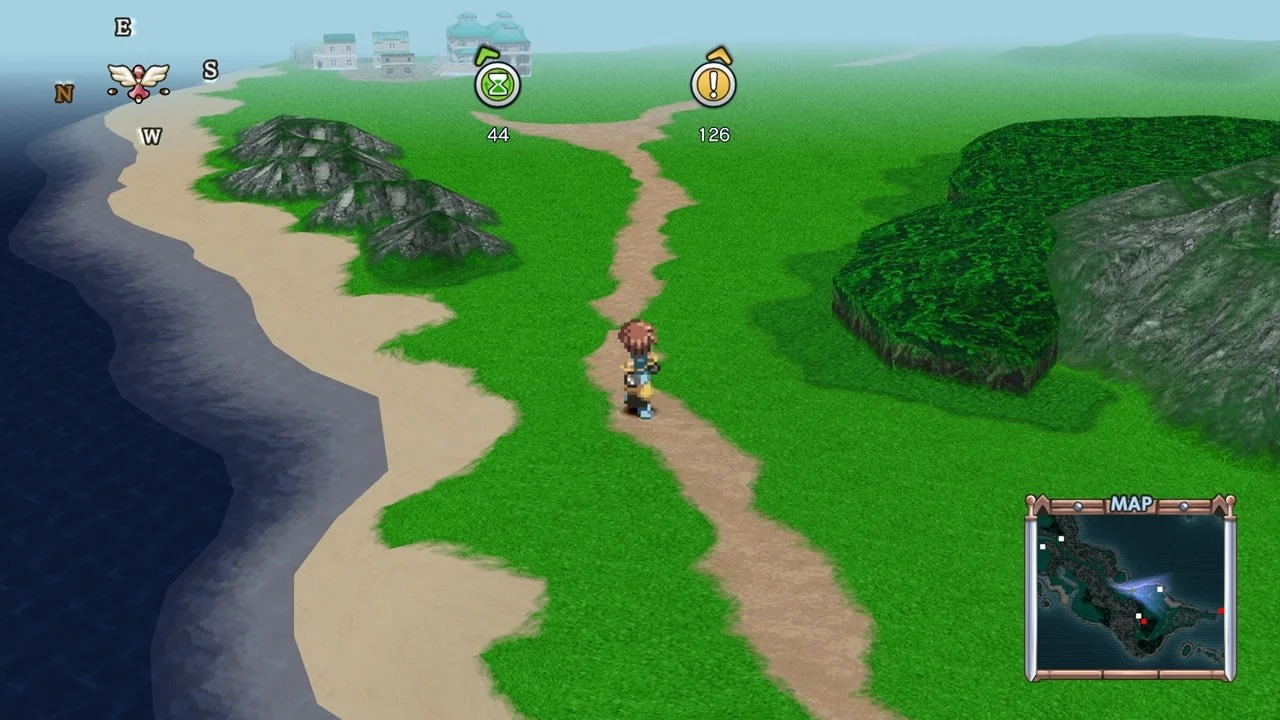
- Remastered adds destination icons with distances, an encounter toggle, high-speed auto-battle, Battle Retry and Quick Recovery.
Two Realms, Three Walkthrough Parts
You play as Reid Hershel, who leaves the remote Inferian village of Rasheans with his childhood friend Farah Oersted and a mysterious girl named Meredy, and the trip becomes a race to stop a collision between two worlds that face each other.
Official source: Tales of Eternia Remastered on the Bandai Namco official site
Two naming traps. Bandai Namco's own material spells the catastrophe two ways: the European feature article says Grand Fall, the Steam store description says Great Fall. Same event, two translations. And this release is titled Tales of Eternia worldwide, so the Tales of Destiny II you remember is the 2001 North American name for the PlayStation game, not this release and not the 2002 PlayStation 2 title. The six playable characters are Reid, Farah, Keele, Meredy, Chat and Max, with Max being the localization name for the character called Fog in the Japanese version.
| Walkthrough part | Story state it covers | What usually blocks people |
|---|---|---|
| Part 1: Inferia | Rasheans through the lower realm | Reading the destination icons, first Craymel Cage assignments |
| Part 2: Celestia | The realm above, the Van Eltia, the sea map | Time-limited events, densest in this stretch |
| Part 3: Endgame and postgame | The final act and everything after the credits | Titles and items that stop being obtainable |
The systems do not change between parts; the available content does. When a fight is the problem rather than the route, start with the battle system guide, then artes and combos.
Where Are You Right Now?
| If this is what you see | Read this | Why |
|---|---|---|
| You just left Rasheans and the yellow mark is new | Beginner guide | Icon types, encounter toggle, early spending |
| The story mark points somewhere unreachable on foot | Part 1: Inferia | Route order for the lower realm |
| A fight keeps killing you and you will not grind | Difficulty modes | Tier changes, and Battle Retry |
| Two Greater Craymels, two mages to split them between | Craymel Cage guide | Who casts what, and late regrets |
| An hourglass icon appeared with a number under it | Sidequests and missables | What expires, and when |
| You are on the water and the map got much bigger | Part 2: Celestia | Ship travel, the expiring events |
| You reached the interior of Shizel Castle and something opened | Part 3: Endgame | Nereid's Labyrinth on a first run |
| You finished the story and want to know what carries over | New Game Plus and carryover | Itemised transfer list, titles included |
What Remastered Changes About Walking Eternia
No pre-2026 walkthrough covers this, because the tools did not exist. The English feature article and the official Japanese change list describe the same set.
| Added feature | What the official text says | Effect on a route |
|---|---|---|
| Destination icons | Point toward your next objective and show the distance | Four types: yellow story, star valuables, hourglass time-limited titles and items, blue new-technique events |
| Encounter toggle | Disable encounters to follow the plot in peace, then switch them back on | Story sections can be walked without fighting |
| High-speed auto-battle | A high-speed mode during auto-battles | Routine encounters cost seconds, not minutes |
| Boost and Battle Retry | A Boost feature, plus a retry option after a defeat | Boost toggles under Menu > Custom; a loss costs a retry, not a reload |
| Quick Recovery | Heals party HP and status ailments at once | You pick the healing method and percentage |
| Graphics and sound toggles | Switch between original and remastered visuals and audio at any time | Remastered or Original rendering and SE, switchable mid-run |
| Autosave and field speed | Saves after map moves and events; hold a button to move quickly | Autosave sits at the top of the load screen |
Official source: Everything New in Tales of Eternia Remastered (Bandai Namco Europe)
Destination icons, Boost, movement and graphics mode all live under Menu > Custom, and the official list says the icon display can be toggled off. It also notes that some gimmicks carry no icon at all, which is why this hub sends you to route pages rather than arrows.
Two Rule Changes That Move Content Earlier
Nereid's Labyrinth, called a high-difficulty dungeon in the official Japanese change list, was originally playable only on a second or later run started from cleared save data. This release unlocks it when you reach the interior of Shizel Castle during a first playthrough. The widely copied English translation of that list calls the castle Balir Castle, while the official Japanese page says Shizel Castle.
Difficulty got the same treatment, and the two official pages disagree on one name. Bandai Namco's English article says Extreme is available from the very start and Unknown unlocks once you complete the game. The Japanese change list phrases it as the Mania combat level becoming selectable from the start of a first playthrough, with Unknown newly added and selectable from a second. Only the name of the from-the-start tier differs. Combat level is changed under Menu > Custom > Combat Level.
Official source: Remastered change list (Bandai Namco official Japanese site)
What Old Walkthroughs Are Actually Measuring
Anything written before October 2026 describes the 2000 PlayStation release or its 2005 PSP port, and the distinction matters more here than for most remasters.
| What the old guides list | Which build it measures | Can you use it in Remastered? |
|---|---|---|
| Level requirements, recommended levels | PlayStation or PSP build | An ordering signal only, never a measurement |
| Boss HP, damage, experience curves, prices | PlayStation or PSP build | No, and this release publishes none either |
| Glimmer Spire floors and puzzle solutions | PlayStation build | Layouts and solutions carry over safely |
| Four-player local co-op advice | PlayStation build | Not applicable, this release is single player |
Two details explain why veterans keep misreading it. The PlayStation original supported up to four players, while this release's store page lists Single-player and no co-op category. Launch-week coverage also reports the remaster is based on the PSP port, which shipped only in Japan and Europe. The four-player support is documented on the Tales of Eternia entry at Wikipedia, and the platform list on the official game page and the Steam store page.
The practical rule: use PlayStation-era walkthroughs for geography, item locations, dungeon layouts and puzzle answers, and ignore every number in them. Steam exposes 50 achievements, 46 flagged rare on the official community achievements page, and for optional fights read hidden bosses, because old guides file a Craymel boss, an EX boss and the spire boss under one heading.
Optional Content, Ordered by Where It Sits
Optional content clusters in three physical areas, not three points on a clock.
| Cluster | What is there | Relevant page |
|---|---|---|
| Inferia towns and piers | The Rasheans river race and the Chamballoon balloon game are both named in the release's achievement list; the Mintche ball game and Barole stone piles come from original-version documentation | Minigames guide |
| Celestia and the sea | Mail delivery, timed detonation runs, and the Van Eltia upgrade path | Sidequests and missables |
| After the credits | The high-difficulty dungeon, the spire, hidden bosses, the transfer screen | EX dungeon and Glimmer Spire, Equipment and items |
The achievement text pins three long-tail projects worth planning around: the legendary hero's equipment is a six-piece set you wear together, the Collector's Book can be completed in full, and the Van Eltia can be fully upgraded. On length, the original release's page lists roughly 33 hours for the main story and 42 with extras, as player averages for that build, while the remaster's own page showed no submitted times on October 17, 2026.
FAQ
Do I need a walkthrough to finish Tales of Eternia Remastered? No. Destination icons with distances let you follow the main story without a route list, and the encounter toggle means you never have to fight your way somewhere you would rather not be.
Can I use a 2001 Tales of Destiny II walkthrough for this release? For geography, puzzle solutions and item locations, yes. For level requirements, boss statistics and prices, no. Use the old guides as a map, never as a measurement.
Which difficulty should I pick for a first playthrough? The tier Bandai Namco's English article calls Extreme is selectable from the first hour, so the assumption that the tough tier must be unlocked is wrong for this release. Unknown, the newly added tier, unlocks after you complete the game.
Is anything missable that a route page should warn me about? Yes, and the release warns you too: the hourglass icon marks events tied to titles and items with a limited acquisition window. The official wording promises nothing beyond that, so unmarked gimmicks still need the guide.
Related Guides
- Tales of Eternia Walkthrough Part 1: Inferia Arc - the opening stretch, Rasheans to the lower realm's end.
- Tales of Eternia Walkthrough Part 2: Celestia Arc - the sea map, the Van Eltia, the expiring events.
- Tales of Eternia Walkthrough Part 3: Endgame - the point of no return and postgame routing.
- Tales of Eternia Craymel Cage and Greater Craymels - the system that changes how every magic-user functions.
- Tales of Eternia Sidequests and Missable Events - what the hourglass icon covers, and what it does not.
More Tales of Eternia Remastered Guides
Boxed copies exist in Japan and Europe on PS5, Switch and Switch 2, while North America was reported digital-only. Game-Key Card details, all dated.
Tales of Eternia Remastered on PS5, PS4, Xbox, Switch, Switch 2 and Steam: target resolutions, the 60fps cap, day-one update sizes and measured load times.
Tales of Eternia Remastered fixes: the Switch analog movement bug and its d-pad workaround, long Switch 1 loads, and the docked Steam Deck 720p lock.
New to Eternia? How the destination icons work, when to use Boost and Battle Retry, which early purchases are traps, and when cooking starts paying off.
The Inferia arc of Tales of Eternia Remastered: route order from Rasheans to the Bridge of Light, the three Greater Craymels, and every party change.
Part 2 covers the Celestia half: the Van Eltia and its upgrades, the Celestian Craymel lairs, Chat and Max joining, and the events that expire.
Part 3 of the walkthrough: the final act, the windows that close first, Nereid's Labyrinth unlocking on a first playthrough, and what carries into run two.
HowLongToBeat has no remaster times yet; the 2000 original averages 33 hours for the story, 42 with sides and 73.5 hours for full completion.